NEUROIMAGING MODELS
Neuromarkers: Population-level predictive brain models
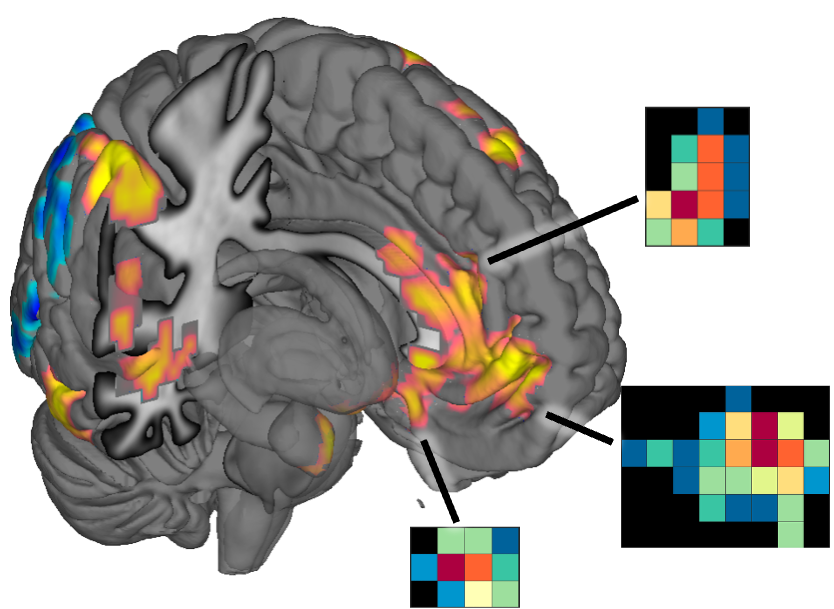
Neuromarkers are population-level patterns of fMRI activity whose expression predicts a stimulus, behavior, mental state, or clinical outcome. In contrast to models individualized for a single person, the models shared here can be applied to data from new participants, allowing open-ended validation across populations, contexts, methodological variations, and outcomes.
These models are in various stages of validation, but all have been successfully validated on at least one independent cohort after model training.
This site focuses on linear models based on fMRI activity, which can be visualized and applied as pattern maps. It does not (yet) include connectivity-based models, or a broader set of neuromarkers based on pathology, electrophysiology, neurochemistry, or other measures.
Browse, explore, and download these patterns for use in new studies.
Loading catalog…
Move over the brain to reveal color · Tap or focus to explore
Neuromarkers
A landscape of brain signatures Grouped by primary domain · Hover or focus to explore · Select to open
Branches organize studies by a curated primary domain. Positions and connections do not measure similarity; studies can span several domains.
Loading neuromarkers…
Orthographic views CANlab atlas labels ↗
Cortical surface Midthickness · fsLR
Percentages are calculated separately within finite, nonzero values of each sign. Ties are retained. This controls visibility, not statistical significance.
Reference publication
Map details
How the surface is displayed
Values are sampled by trilinear interpolation at HCP S1200 fsLR midthickness vertices using the map’s world-coordinate affine. This is an approximate MNI surface visualization, not a nonlinear registration or a predictive surface model. Exact MNI template variants are not documented for all source maps. Use orthographic views to inspect alignment and subcortical weights.
Surface visibility uses the same voxel-derived cutoffs as the slices; interpolation can change the fraction of visible vertices. Downloads retain the full volume.